
Paws & Pastries: Merge Café
TreesPlease Games LtdCasual
3.635.00 Reviews
- Version
- 1.7.2
- Installs
- 10.00K
- Age Rating
- Everyone
Screenshots

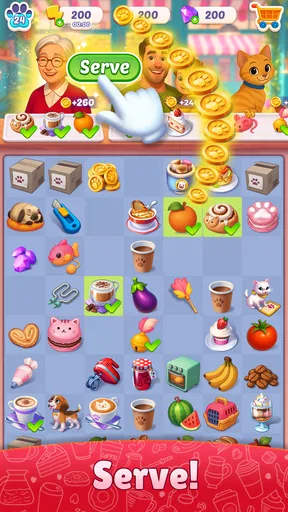

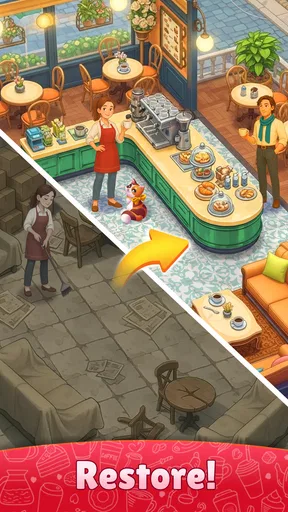

Our Review of Paws & Pastries: Merge Café
 Analysis by Appyee
I went into Paws & Pastries: Merge Café expecting a gentle casual game, and that is exactly the space it occupies: a light café-building experience built around merging objects, helping animals, and following romantic story elements. The central appeal is easy to understand. You combine matching items, use the results to develop your café, and gradually make the setting feel more personal while the animal-rescue and relationship threads give the routine a little narrative purpose.
That combination makes it more than a simple matching board, but it is not trying to be a demanding management simulator either. I found it most enjoyable in short sessions, especially when I wanted something colorful and low-pressure rather than a game that required constant concentration. The important question is whether you want a cozy progression loop with a café theme, or whether you are looking for deeper strategy, faster action, or a completely unrestricted decorating tool.
How I judged the café experience
For me, the first decision point is the merge system. A merge game lives or dies by how satisfying its small decisions feel: what to combine now, what to keep for later, and when to clear space for a better objective. In this game, the café setting gives those choices a clear purpose. Instead of merging objects with no context, I am working toward a place that is meant to grow, while the animal and romance elements provide reasons to continue beyond the next combination.
The second criterion is the strength of the surrounding loop. A merge board can become repetitive if every task feels identical, so I paid attention to whether the café, rescue, and relationship themes made progress feel varied. They help give the game a warmer identity than a bare puzzle app, although players who need constant mechanical change may still notice the familiar rhythm after longer sessions.
The third issue is pacing. Casual games are often used in very different ways: some people open them for a few minutes while waiting for a bus, while others settle in for a longer evening session. This title suits the first group particularly well. Its premise is approachable, and the individual actions are simple enough to understand without studying a complicated rule set. I would not choose it as my main game if I wanted a long, uninterrupted challenge with demanding planning.
Finally, I considered how much patience the progression asks for. The game is free to start, but optional purchases range from $0.99 to $99.99 per item. That wide range is worth keeping in mind before getting attached to the progression loop. I always recommend treating the free experience as a trial: play long enough to decide whether the basic rhythm is enjoyable on its own, and do not assume that spending will automatically make the game more satisfying.
The merge loop works best when I plan one move ahead
The most useful habit I developed was resisting the urge to combine everything immediately. In a merge game, an empty space can be more valuable than a quick upgrade. I found it better to look at the current task, identify which objects are actually helping that goal, and leave unrelated pieces alone until the board becomes easier to read. This is a small change, but it prevents the common frustration of filling the available area with items that are not useful right now.
I also learned to separate progress from decoration in my mind. The café theme makes it tempting to treat every improvement as a visual reward, but the practical value of a move comes from how it supports the next objective. When I focused on completing the immediate chain first, the game felt calmer. When I chased every possible merge at once, the board became more cluttered and my decisions became less deliberate.
This is one of the less obvious strengths of the design: the game can be relaxing without being completely mindless. It does not demand expert tactics, but it rewards a little organization. Players who enjoy sorting, planning small combinations, and watching a setting gradually develop will get more from it than players who simply tap through every available action.
The café theme gives the routine a reason to continue
The café is not just a decorative label placed over a puzzle. It shapes the mood of the game and makes the rewards feel connected. I liked having a setting that suggested hospitality and improvement rather than competition. The animal-rescue thread adds another emotional layer, while the romance angle gives the broader progression a more personal tone.
That mixture will not appeal equally to everyone. If you prefer a pure puzzle board, the story material may feel like an interruption between merges. I had the opposite reaction: the extra themes helped break up the repetition and made the next objective feel more meaningful. The game works best when I accepted that it was offering a cozy narrative wrapper, not merely a high-score challenge.
One practical tip is to play with a clear purpose for each session. I might open it intending to make progress on the café, then switch attention toward an animal-related task or a character moment when that becomes available. Thinking in these smaller goals makes the experience feel less like an endless resource treadmill. It also helps answer a common concern about casual games: yes, it can fit into brief daily play, but it is more enjoyable when I decide what kind of progress I want before I start.
Who will probably enjoy it most
I would recommend this game first to players who like gentle merge mechanics but want a setting with more personality than a generic collection board. It is a good match for someone who enjoys café makeovers, animal-centered stories, and light romance without needing complex controls. It also suits people who prefer games that can be understood quickly and revisited in short bursts.
It may also work for a player who is new to merge games. The basic idea is easy to grasp, and the café context makes the early decisions feel intuitive. You do not need to arrive with knowledge of a large competitive community or a complicated strategy guide. I found the game more welcoming when I treated it as a relaxing routine rather than something I needed to optimize perfectly.
The audience is reflected in its Everyone age rating. That makes the overall presentation accessible for a broad audience, although adults should still remember that the free download includes optional purchases. For a shared family device, I would set a spending boundary before handing the game over, particularly because the available purchase range includes both small and much larger items.
Where another casual game may be a better fit
I would steer you toward a different option if your main goal is deep café management. This game uses the café as part of a merge-and-story experience, so it should not be confused with a detailed business simulator where staffing, menus, supply chains, and customer flow are the main challenge. If those systems are what keep you engaged, a dedicated management game will likely offer more control.
A traditional match-three title may also be better if you want quick, self-contained rounds with a clear win condition. The merge format here is more about building chains and supporting longer-term progress. That can feel rewarding, but it is less suitable when I want a fast burst of competitive puzzle action and no surrounding narrative.
On the other hand, players who mainly want unrestricted interior design should look for a decorating-focused game. The café theme is appealing, but the experience is still driven by progression and merging. I would not install it expecting a blank room where every visual choice is immediately available. Its satisfaction comes from earning and combining things over time, not from instant creative freedom.
There is also a meaningful difference between this and a story-only mobile game. The romance and animal-rescue elements add motivation, but they do not replace the merge loop. If your priority is reading a branching narrative with minimal gameplay, a visual novel may be a better match. Here, the story works as a reason to keep playing the café activities rather than as the entire product.
Free access, optional spending, and the cost of changing your mind
The game is free, which lowers the risk of trying it. I would use that advantage carefully: install it, learn the merge rhythm, and decide whether the café progression feels rewarding before considering any purchase. The optional items are priced from $0.99 to $99.99, so the difference between a casual trial and a serious spending habit can be substantial.
My advice is to set a personal rule early. For example, I might decide that I will only spend when a purchase solves a genuine annoyance without becoming the reason I play. If I notice that I am opening the game mainly to justify a previous purchase, that is a sign to step back. The most important test is whether the free loop already gives me a pleasant experience.
This is also where the cost of switching matters. If you begin looking for a different merge game later, the transferable skill is your understanding of board space and combination planning, but the emotional investment in the café and its characters will not carry over. I would therefore avoid spending heavily until I know that the setting itself—not just the general merge formula—is what keeps me returning.
There is a second kind of switching cost: time. A slower, story-led merge game asks you to build attachment gradually. Moving to a faster puzzle game may feel liberating if you are tired of waiting for longer-term progress, but it will also remove the café-building and rescue context that gives this title its identity. Neither approach is automatically better; the right choice depends on whether you value atmosphere or immediate mechanical variety.
What the current release tells me about its place
Paws & Pastries: Merge Café comes from TreesPlease Games Ltd and is currently at version 1.7.2, with support beginning at Android 9. Those details matter mainly for practical reasons: I would check the operating system on an older phone before planning to play, and I would keep the game updated so the experience matches the current release available through the platform.
The game has passed 10K installs and holds a 3.6 average from 95 ratings, alongside 35 written reviews. I read that overall reception as mixed but viable rather than as a universal recommendation. The numbers suggest there is an audience for the concept, while also reminding me that the combination of merge pacing, story, and optional spending will not suit everyone equally.
That balance matches my own impression. The game has a clear personality and an inviting premise, but its appeal depends heavily on tolerance for repetition and gradual progress. I would not describe it as a technical showcase or a strategy-heavy experience. Its value is in the blend: a soft café setting, simple merge decisions, animal rescue, and romance arranged into a routine that is easy to revisit.
Everyday scenarios where it fits naturally
I can see myself opening it during a short break after finishing a task. I would check the current objective, make a few careful combinations, clear space, and close the game before it starts to feel like work. That is a better use case than expecting it to carry a full evening by itself. The low-pressure format makes it suitable for those small gaps when I want a distraction with some visible progress.
It also fits a quiet wind-down routine. The animal and café themes are gentler than combat or competitive ranking systems, and the romantic storyline gives the session a sense of continuity. I would still avoid playing automatically while distracted, because the board benefits from basic planning. A few seconds spent deciding what to preserve can make the next visit much smoother.
For someone sharing recommendations with a friend, I would describe it as a low-commitment game with a cozy identity, not as a substitute for a full simulation. That distinction sets the right expectation. If your friend likes combining items and watching a fictional place grow, there is a good chance the concept will click. If they dislike energy-style pacing, repeated collection tasks, or in-app purchase prompts in free games, they should approach it cautiously.
My recommendation after weighing the trade-offs
I recommend trying Paws & Pastries: Merge Café if you want a free casual game that combines merge puzzles with café improvement, animal rescue, and romance. Its strongest quality is the way those themes give a familiar mechanic a warmer destination. I enjoyed it most when I played in short sessions, planned around the current objective, and treated the café as a gradual project rather than a race.
I would skip it if you need deep restaurant strategy, instant decorating freedom, competitive puzzle rounds, or a story that stands entirely on its own. Those needs point toward more specialized alternatives. I would also be careful with optional purchases: the free entry is useful for testing the game, but the available items extend from $0.99 to $99.99, so a clear spending limit is sensible.
Overall, this is a pleasant choice for the right kind of player rather than a universal casual recommendation. TreesPlease Games Ltd has built a recognizable cozy package around the merge format, and the current release provides enough of a foundation to judge whether that package suits you. If the idea of restoring a café while helping animals and following a gentle romance sounds more appealing than chasing high scores, it is worth starting free and seeing whether the atmosphere keeps you coming back.
Verdict
Strengths of Paws & Pastries: Merge Café
- Relaxing merge gameplay that is easy to learn and play in short sessions.
- Charming café theme with cute animal characters and pastry designs.
- Frequent goals and orders provide a clear sense of progression.
- Suitable for casual players who prefer gentle, low-pressure challenges.
- The colorful presentation makes the game appealing to younger audiences.
Limitations of Paws & Pastries: Merge Café
- Energy limits can interrupt play when you want longer sessions.
- Progress may feel slow without spending premium currency.
- Merge boards can become crowded and require careful space management.
- Some tasks rely heavily on waiting for timers to finish.
- The repetitive merge loop may not satisfy players seeking deep strategy.
Similar Picks in This Category
View All
My Talking Angela
Outfit7 Limited4.2

My Talking Tom
Outfit7 Limited4.3

Pou
Zakeh4.2

My Talking Tom 2: Pet Game
Outfit7 Limited4.3

Candy Crush Saga
King4.6

Bridge Race
Supersonic Studios LTD4.1
Frequently Asked Questions
What is Paws & Pastries: Merge Café about?
Paws & Pastries: Merge Café is a cozy merge-and-management game where you combine matching ingredients and café items to prepare treats, serve customers, and improve your own animal-themed café. As you progress, you unlock new recipes, decorations, story moments, and adorable characters. The gameplay is relaxed and easy to understand, although completing larger orders can require patience and careful planning.
How does the merging system work in Paws & Pastries: Merge Café?
The main gameplay mechanic involves dragging two identical items together to create a more advanced item. These upgraded ingredients or café objects can then be used to complete customer requests, earn rewards, and expand the café. The board can become crowded, so it is important to avoid merging randomly. Planning combinations and saving useful items makes progression smoother, especially during busier tasks and limited events.
Can Paws & Pastries: Merge Café be played offline?
Some basic merging activities may remain accessible without a constant internet connection, but the full experience can depend on online features. Events, advertisements, cloud synchronization, purchases, updates, and certain rewards may require internet access. If you plan to play while traveling, it is best to open the game online first and check which features are available offline on your particular Android or iOS device.
Does Paws & Pastries: Merge Café include in-app purchases or advertisements?
The game may include optional in-app purchases and advertising, as is common with free-to-play merge games. Players can typically use rewarded advertisements for extra energy, bonuses, or additional opportunities, while purchases may speed up progress or provide premium resources. You can enjoy the core gameplay without spending money, but waiting for energy and managing limited resources may be necessary.
Is Paws & Pastries: Merge Café suitable for children and casual players?
Paws & Pastries: Merge Café is designed to be approachable, with simple drag-and-merge controls, colorful visuals, friendly animal characters, and generally gentle café-themed gameplay. It can suit casual players who prefer short sessions rather than fast action. Parents should still review the store rating, privacy information, advertisements, and purchase settings, particularly if children will be playing on a shared device.
Play our best games!


